Remote property management: how to manage your properties in France from abroad (2026 guide)
Self-management, agency or independent manager: here is the complete system for letting and managing a property in France when you live abroad, with the real costs, the time to allow for and the rules to follow.
“And what if the water heater breaks while I am in Singapore?” This is the question that blocks the most expats before investing in France, far more than the loan or taxation. I know it well: I bought my first property from Hong Kong, more than 10,000 km away, then I lived in Dubai and Luxembourg. For six years, I managed all my homes myself, without an agency.
This guide gives you the complete system: the three ways to manage remotely, what they cost, the time they take and the rules to follow. With ImmoPourExpat, we have supported more than 1,000 non-resident French people in more than 60 countries, and management is part of the project from the start: a well-chosen, well-renovated and well-organised property can be managed remotely without stress. It is the last step of the method for investing in France from abroad.
The essentials
Distance is not the risk. Unpaid rent concerns 1 to 3% of tenants, and rigorous selection brings that figure down further.
You have three ways to manage: yourself, through an agency (5 to 10% of rents) or through an independent manager (around 5%, often at a flat fee).
Everything can be done remotely: video viewing, online file, lease signed remotely, keys handed over by the managing agent (syndic) or a key box.
Allow 1 to 2 hours a month at a normal pace if you manage yourself, more when several tenants change at the same time.
You can delegate management, not taxation or the steering of your portfolio.
Is distance really a risk?
Unpaid rent: 1 to 3% of tenants
Press headlines give the impression that renting in France is a contact sport. The figures say otherwise: according to a report of the National Assembly, unpaid rent concerns between 1 and 3% of tenants. And those who end up in arrears rarely had a good file at the start. It is therefore a risk handled at selection, not afterwards.
“Out of more than 170 tenants, I had a few small hiccups, but nothing that stopped me from collecting my rents.” Frédéric Moreau, founder of ImmoPourExpat
Squatting: a media risk, not a statistical one
Squatting makes the headlines, but it remains exceptional. The first review of the squat observatory, published by the Housing Ministry, recorded 124 eviction requests sent to prefects in nearly five months, for the whole of France. And the procedure is quick today: the owner of a squatted home can refer to the prefect, who must reply within 48 hours. Do not confuse the two subjects: a squatter entered without right, whereas a tenant who no longer pays falls under another procedure.
The real subject: your system, not your kilometres
A home that attracts good tenants ticks three boxes, and they are decided at the purchase:
An operating strategy suited to local demand. A 120 m² does not interest students, a studio in a village of 500 inhabitants interests almost nobody.
A market-price rent, neither overpriced nor sold cheap.
A property in good condition, well laid out and well decorated.
That is why management is prepared upstream, from the choice of the property: I detail this logic in my guide toproperty investment for expats.
“It is not distance or living abroad that is the problem. It is bad systems.” Frédéric Moreau
Self-management, agency or independent: the 3 ways to manage from abroad
Managing yourself is nothing exotic: according to the same parliamentary report, real estate professionals manage only 35% of the private rental stock. The difference, for you, is that you do not live next door. Here are your three options.
Remote property management: comparison of the three management modes for an expat landlord
Self-management
Estate agency
Independent manager
Cost
No fees
5 to 10% of rents, plus ancillary fees
Around 5% of rents, often at a flat fee
On €12,000 of rents per year
0 €
600 à 1 200 €
About €600
Your time
1 to 2 h a month, more at tenant changeover
Almost none
Almost none
Control over tenant choice
Total
Limited
High: you set your criteria
Watch point
Having a well-oiled system
Staff turnover, delays, property treated as a number
Takes longer to find, professional card to check
Who it suits
First property, tight budget, desire to learn
Little time, priority on peace of mind
Several properties in the same city
Managing yourself: the most profitable option
That is what I did for six years, for a simple reason: at the start, I wanted to keep every euro for the next project. Result: more than €55,000 of fees saved, enough to fund thedown payments of several mortgages. Two other benefits matter just as much. You learn: tenants’ expectations, real costs, friction points. And you decide everything, by your criteria. The flip side is that you are the system.
“I saved more than €55,000 over five to six years. That represents two or three down payments to buy a property of around €200,000.” Frédéric Moreau
Delegating to an agency: peace of mind, provided you choose well
The advantage is obvious: you have almost nothing to do. So is the cost: between 5 and 10% of rents, often with ancillary fees on top (letting, inventory check, file fees).
But the real risk is quality. In a large structure, managers change often, re-letting delays lengthen, and the agency may accept a tenant you would not have chosen. One of our members, before joining us, had entrusted his properties to the largest agency in his city: it had not noticed that a tenant had not paid for a month.
My advice: aim for a small local agency, with a stable team and a contact who knows the ground. And test its rigour from the first exchanges: if it is approximate with you, it will be with your tenants.
“In a big agency, your property is just one number among a hundred. Big structure, big turnover: the agents don’t even know your home.” Frédéric Moreau
The independent manager: the best of both worlds
This is the solution I chose. An independent works on their own account, alone or with an employee. They know each home and each tenant, answer directly on WhatsApp, decide quickly and agree to do the small favours a large agency refuses. On cost, it is generally around 5% of rents. Mine manages my whole portfolio with a fixed monthly flat fee per home, which works out at about 3% of my rents.
To find one: ask for recommendations from your notary, your managing agent (syndic) or other landlords, and look in investor groups in your city. A reflex before signing: managing other people’s property for pay is a regulated activity. Ask for their professional card marked “Property management” (Gestion immobilière) and a written mandate.
This is also where a network saves time. In the ImmoPourExpat community, you find investors and managers already in place in your city, and we help you choose the management mode suited to your property even before the purchase.
My system for managing remotely, in 5 steps
1. Professional photos and a full video of the property
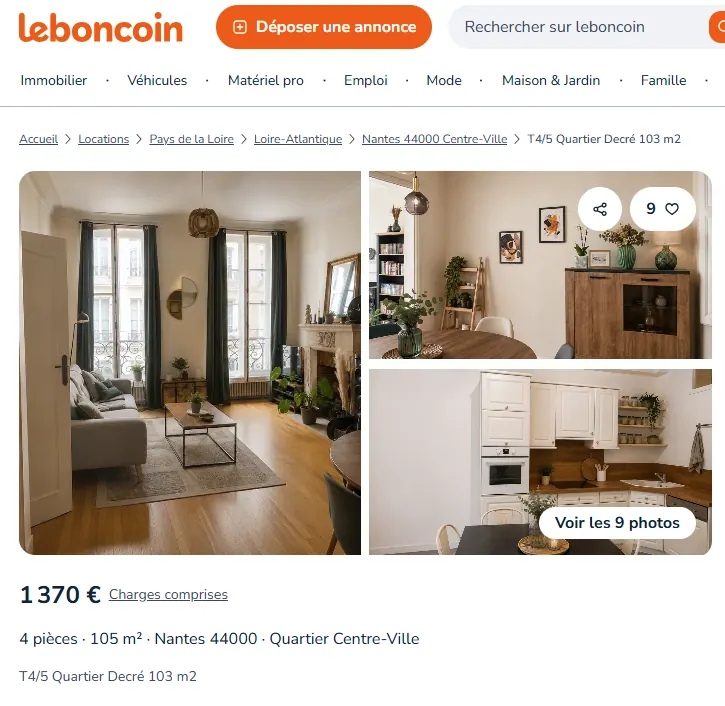
As soon as the works are finished, have photos taken by a professional. Allow €150 to €200, an expense you can deduct from your rental income under the actual regime. Also shoot a full video of the home: it will serve for the listing, then for viewings. Then write a precise listing, which frames the profile you are looking for. I publish almost everything on Leboncoin, and on Studapart when I am targeting students.
2. Selection on file, with checks
Ask for a complete file, staying within the list of documents you are allowed to demand : ID, last three payslips, employment contract or employer certificate, latest tax notice, latest rent receipts. For a student, ask for the same documents from the parents acting as guarantors. The classic benchmark: income equal to three times the rent.
Then, check. Fake files exist, and they can be detected:
Income must be consistent between the tax notice and the payslips.
The employer can be called in case of doubt. I did it for a candidate who worked in a bakery: one phone call, and the doubt was lifted.
A call or video call with the candidate gives you the last element: the feeling.
On guarantees, think of Visale, the free guarantee from Action Logement. It covers applicants aged 18 to 30 whatever their status, and certain employees over 30 subject to income conditions. It covers unpaid rent during the first three years of the lease. The alternative is unpaid-rent insurance, which generally costs 2.5 to 3.5% of the rent. Note, you cannot combine it with a guarantor, unless your tenant is a student or apprentice.
3. Viewings without travelling
The video viewing (my favourite). Once the file is received, I send the video link. No travel, no slots to arrange. Once the file is validated, the candidate can of course see the home in person. Many prefer the video, especially those moving from another city.
Viewing by the current tenant. At the end of a lease, it is they who open the door. It is also in their interest: they choose their times.
The secure key box, with a guided video-call tour.
The key with a trusted shopkeeper or neighbour. For one of my homes, it is in a bar open every day, with a password.
Group viewings during a trip back to France, only if the calendar allows.
4. Lease, keys and inventory check
I have the lease signed remotely and the security deposit paid before any key handover. Then, two simple solutions: the building’s managing agent (syndic), to whom I pass on the tenant’s identity, or a key box if you own the whole building.
That leaves the inventory check. My advice: never skip it, even remotely. Without an inventory check, the home is presumed to have been handed over in good condition, but the law removes this presumption from whoever obstructed its being carried out. So have it done by someone on site: your referent, your manager or a mandated professional. In the latter case, the costs are shared and the tenant’s share is capped at €3 per m². Attach the photos and video of the home to the lease: after a renovation, they prove its condition. At exit, same logic: a video call with the tenant on departure day, and an on-site check.
5. Rents collected without thinking about it
In my leases, rent is payable by the 1st of the month at the latest. At signing, I ask the tenant to set up a standing order. You cannot impose direct debit in the lease, but a standing order proposed at the outset is accepted by almost everyone: the tenant no longer has to think about it either. I then send a summary message and open a WhatsApp conversation per tenant. Also keep a bank account in France: it receives the rents and repays your non-resident mortgage.
Maintenance, breakdowns and emergencies: who steps in when you are far away?
A reliable tradesperson, the centrepiece
The key to calm day-to-day management is a versatile tradesperson ready to step in when a problem arises. Find them before you need them, ideally during the renovation works. Also plan a visit to the home once a year, by that tradesperson or by a relative, or failing that a video-call tour with the tenant every six months.
The referent: your trusted person on site
From my early days, I understood I needed someone on site: my referent. A member of your family, a friend, or a professional you have already worked with. Depending on their level, they can take on administrative, technical or rental tasks. Four qualities matter: a good attitude, the ability to carry out a task without rediscussing everything, a minimum of availability and, if possible, autonomy. Give them time to build up skills.
The ImmoPourExpat local relay
Not everyone has a relative in the city where they invest. That is why I set up, for ImmoPourExpat members, a local relay in each major French city. This is an investor in the area: they visit for you, send you a report, estimate the renovation works and can follow the site. Distance disappears from the purchase onwards, and you approach the letting with a clean property and a contact on site. It is the extension of our support in remote renovation.
Insurance not to forget
Non-occupant landlord insurance (PNO) covers your liability when you do not live in the home. It is mandatory in co-ownership buildings and strongly advised elsewhere. For their part, your tenant must be insured: ask for their certificate every year.
Want a property that is easy to manage remotely? Management is decided from the choice of the property, the city and the type of rental. Let’s talk about your project before you sign. Request my free analysis
How long does it really take?
With this system, managing my properties took me about two hours a month in a normal period. In high season, around September, when several tenants move in at the same time, it could rise to seven or eight hours in the month, sometimes ten. Ten hours a month is still two hours a week. The more properties you have, the more this time grows: that is the signal that you will have to delegate one day.
What you cannot delegate: taxation and steering
A manager takes care of tenants, not of your strategy. Two subjects stay on your desk, even with the best agency in the world:
Your taxation. The choice of regime changes your result far more than management fees. See how thetax on a non-resident’s rental income is calculated, what is made possible by the LMNP for a non-resident and the effect of the tax treaty of your country. Good to know: under the actual regime, management fees are deductible from your rents.
Your financial steering. Tracking rents, costs, cash position, the next project: nobody will do it for you.
“Delegating without mastering sounds good. But how do you judge someone’s work if you don’t have the knowledge to assess it?” Frédéric Moreau
I delegated the day I reached the goal I had set myself: more than €5,000 of property income per month. My portfolio now exceeds €200,000 of rents a year, and managing it alone no longer made sense. But I delegated knowing exactly what to ask and what to check.
It is not the only path. Many of our members prefer to delegate from the first property, or to mix the two, and that is fine: your time and peace of mind also have a value. The essential thing is to choose knowingly.
Managing remotely does not prevent growing your portfolio. Here is the experience of an expat who generates €2,500 of cash flow per month from his properties in France.
FAQ: remote property management
Can you manage a rental property in France yourself when you live abroad?
Yes. Nothing obliges you to go through an agency, and most of the private rental stock is managed directly by owners. Remotely, you need a system: video viewing, selection on file, rents by standing order, and a trusted person on site for keys, the inventory check and emergencies.
How much does a property management agency cost?
Between 5 and 10% of rents collected, often with letting, inventory check or file fees on top. An independent manager generally charges around 5%, sometimes at a flat fee per home. Under the actual regime, these fees are deductible from your rental income.
Is non-occupant landlord insurance mandatory?
In co-ownership buildings, yes: each co-owner must insure their civil liability, whether or not they occupy the home. For a detached house, it is not mandatory, but it remains strongly advised when you live thousands of kilometres away.
Furnished or unfurnished rental: which is easier to manage remotely?
Unfurnished rental requires fewer interventions: the lease lasts three years and tenants stay longer. Furnished, the lease is one year (nine months for a student), so you re-let more often, but rents are higher and taxation is often more favourable. With a good letting system, turnover is no longer a problem.
Ready to invest in France without suffering the distance? We have supported more than 1,000 French people in more than 60 countries, from the property search to letting it, with a local relay in each major city. Book your free diagnostic. Book a meeting with an expert